



How about more insights? Check out the video on this topic.
Introduction
Traditional SQL databases have long been the industry standard, but as modern applications demand more flexibility and scalability, NoSQL databases have emerged as a compelling alternative. NoSQL, which stands for “Not Only SQL,” offers a range of database technologies designed to handle large volumes of unstructured and semi-structured data.
Why NoSQL?
NoSQL databases are particularly well-suited for applications that require:
- Flexibility: Unlike SQL databases, NoSQL databases don’t adhere to a rigid schema. This allows for dynamic data structures and easy schema evolution, making them ideal for applications with rapidly changing data requirements.
- Scalability: NoSQL databases are designed to scale horizontally, meaning you can add more servers to handle increased load. This contrasts with traditional SQL databases, which often require vertical scaling (upgrading hardware) to accommodate growth.
- High Availability: By replicating data across multiple servers, NoSQL databases can maintain high availability, even in the event of server failures.
- Performance: NoSQL databases are optimized for speed, especially when dealing with large datasets and high-throughput operations.
When to Use NoSQL?
Consider using a NoSQL database for the following scenarios:
- Real-time applications: NoSQL’s high performance and scalability make it ideal for applications that require real-time data processing, such as social media platforms and online gaming.
- Big data: NoSQL databases can handle massive amounts of data, especially when the data is unstructured or semi-structured.
- High-write workloads: NoSQL databases are well-suited for applications that require frequent data writes, as they can distribute the load across multiple servers.
- Rapid application development: NoSQL’s flexible schema and ease of use can accelerate development time.
NoSQL vs SQL: Understanding the Key Differences
Fundamental Architectural Differences
Schema Design
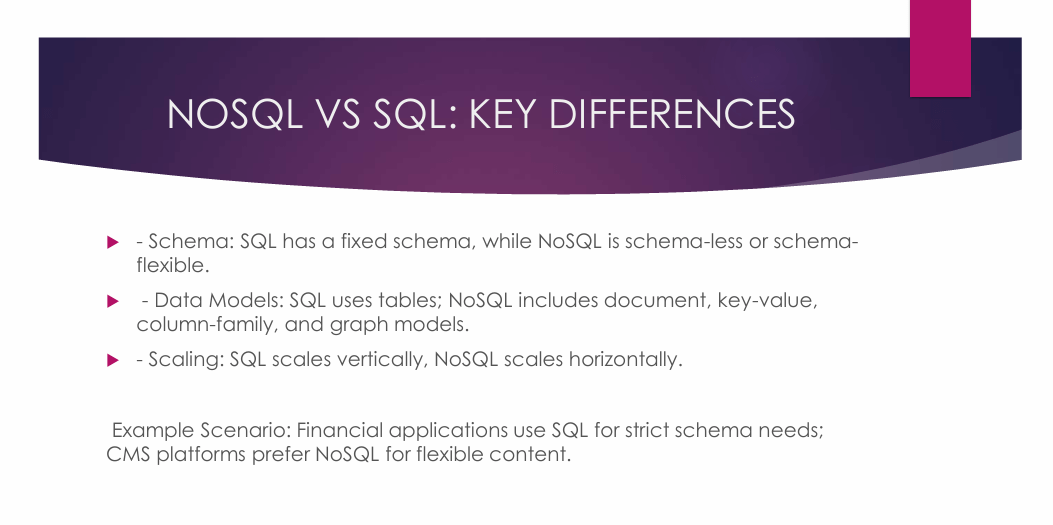
While SQL databases enforce rigid, predefined schemas that act as strict blueprints for data organization, NoSQL takes a more flexible approach. This schema-less (or schema-flexible) architecture allows for:
- Dynamic data modeling
- Easy schema modifications
- Rapid application development
- Efficient handling of evolving data structures
Data Modeling Approaches
SQL and NoSQL fundamentally differ in how they structure data:
SQL:
- It relies on tables with fixed columns and rows
- Enforces relationships through foreign keys
- Maintains data integrity through ACID properties
NoSQL:
Offers multiple data models:
- Document-based storage
- Key-value pairs
- Column-family structures
- Graph databases
NoSQL Database Types Deep Dive
1. Document Stores
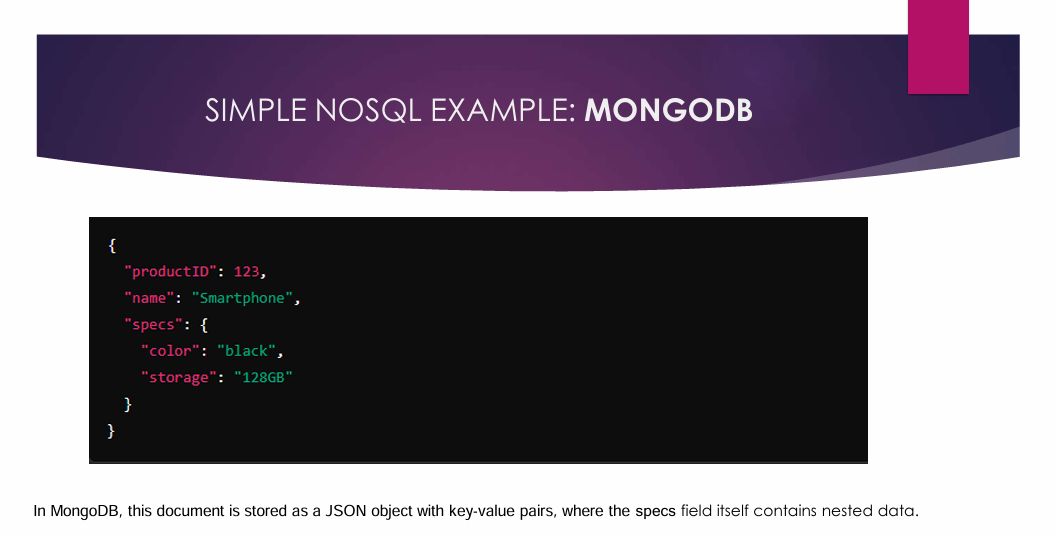
Document stores like MongoDB excel at handling semi-structured data in JSON-like formats. Here’s a practical example:
Key Applications:
- Content Management Systems
- User Profile Management
- Product Catalogs
2. Key-Value Stores
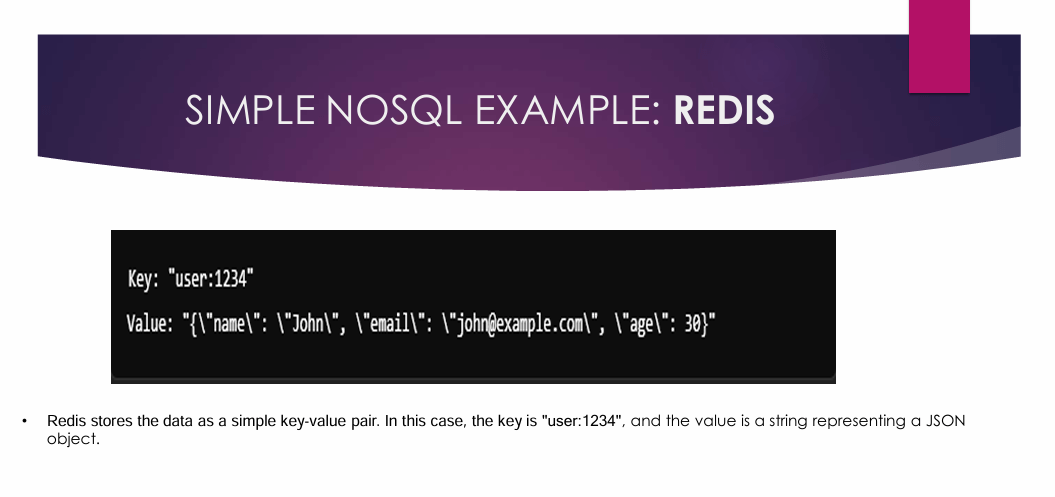
These databases operate on a simple yet powerful principle of key-value pairs, making them ideal for:
- Session Management
- Caching Systems
- Real-time Data Processing
Example Use Case: Redis for session storage and caching
3. Column-Family Stores
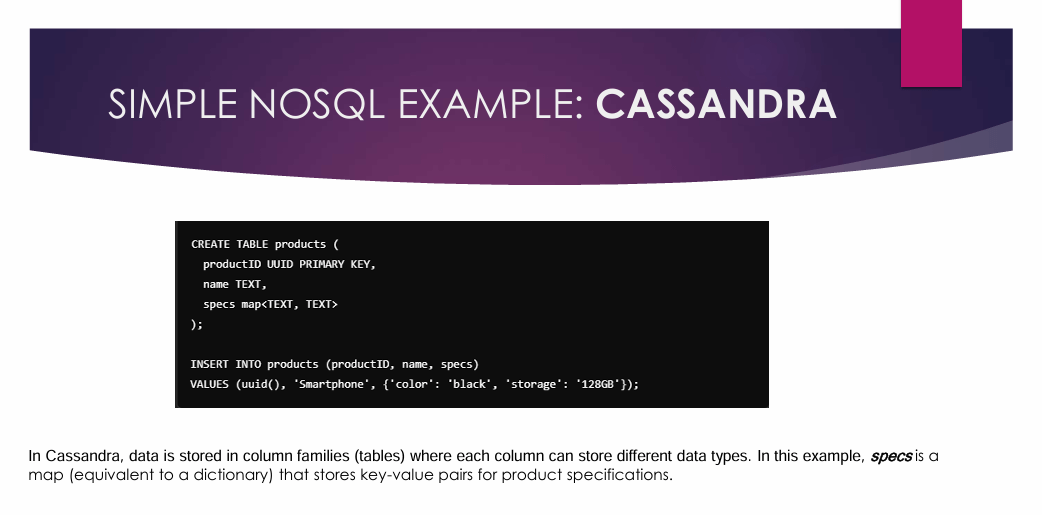
Databases like Cassandra organize data by columns rather than rows, offering:
- Exceptional scalability
- High-performance read/write operations
- Efficient big data processing
Cassandra Example Structure:
4. Graph Stores
Perfect for handling interconnected data, graph databases like Neo4j excel in:
- Social Network Analysis
- Recommendation Engines
- Fraud Detection Systems
Scaling Strategies
SQL (Vertical Scaling)
- Upgrades single server capacity
- Increases hardware resources
- Limited by hardware constraints
NoSQL (Horizontal Scaling)
- Distributes data across multiple servers
- Adds more machines to handle increased load
- Virtually unlimited scaling potential
This architecture makes NoSQL particularly suitable for:
- High-traffic applications
- Big data processing
- Real-time data analytics
Identifying the Right Use Cases for NoSQL Databases
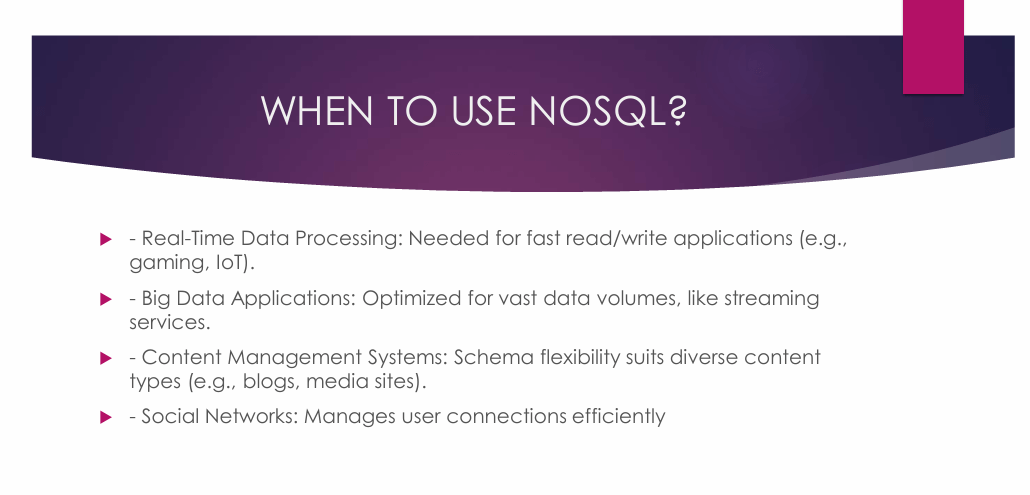
Real-Time Data Processing
NoSQL databases excel in scenarios requiring rapid data processing and real-time analytics:
- IoT sensor data collection
- Gaming application states
- Live streaming analytics
- Real-time event processing
Big Data Management
When dealing with massive data volumes, NoSQL offers distinct advantages:
- Efficient handling of petabyte-scale data
- Streamlined data ingestion
- Flexible data storage formats
- Distributed processing capabilities
Content Management Systems
Modern CMS platforms benefit from NoSQL’s flexibility in handling:
- Diverse content types
- Dynamic content structures
- Rich media storage
- User-generated content
Social Network Platforms
Social media applications leverage NoSQL for managing:
- User relationships and interactions
- Activity feeds
- Content sharing
- User engagement metrics
Scenarios to Avoid NoSQL
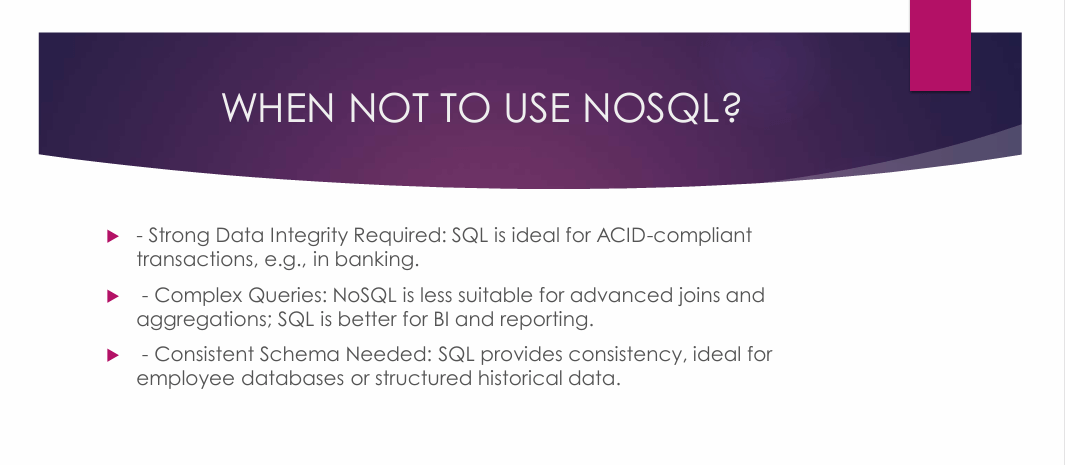
1. Mission-Critical Financial Systems
Applications requiring strict ACID compliance should stick to traditional SQL:
- Banking transactions
- Payment processing
- Financial record-keeping
- Accounting systems
2. Complex Analytics Requirements
When dealing with sophisticated data analysis:
- Business intelligence applications
- Advanced reporting systems
- Multi-table joins
- Complex aggregations
3. Fixed Schema Applications
Systems with stable, well-defined data structures:
- HR management systems
- Inventory management
- Standardized record-keeping
Comprehensive Analysis: Pros and Cons
Advantages
- Schema Flexibility
- Dynamic data structure adaptation
- Easy schema modifications
- Support for evolving business requirements
- Reduced development overhead
- Horizontal Scalability
- Distributed architecture
- Linear performance scaling
- Cost-effective growth
- Better resource utilization
- High Availability
- Minimal downtime
- Automatic failover
- Distributed data redundancy
- Robust fault tolerance
Disadvantages
- Query Limitations
- Restricted complex query support
- Limited join operations
- Basic aggregation capabilities
- Less sophisticated query optimization
- Reduced ACID Compliance
- Limited transaction support
- Eventually consistent model
- Possible data integrity challenges
- Trade-offs in data consistency
Conclusion
While NoSQL offers powerful solutions for modern application development, it’s crucial to understand that it’s not a one-size-fits-all solution. Success lies in choosing the right tool for specific use cases while acknowledging both its strengths and limitations.
The future of database architecture likely lies in polyglot persistence, where organizations leverage both SQL and NoSQL solutions to address different aspects of their data management needs.
We would like to thank Alabi Abdullahi Ayodeji for his insightful presentation on NoSQL databases. His expertise has provided valuable insights into the world of NoSQL and its applications.
Related posts
Bridging Two Worlds: An Introduction to Document-Relational Databases
Explore the fusion of document and relational databases. Bridging Two Worlds: An Introduction to Document-Relational Databases.
Unveiling Apache Cassandra: A Deep Dive into Distributed Efficiency
Delve deep into the architecture of Apache Cassandra, a distributed key-value store that serves as a critical component in managing and analyzing large volumes of data in high-scale applications, using Nvidia as a case study.
Open Standards and Licensing in Database Technology with Mark Stone
Explore the world of open standards and licensing in the dynamic realm of database technology. Join Mark Stone in discussing the future of document databases.
The Current State of MongoDB Alternatives, and Two Years of FerretDB.
Discover FerretDB, an open-source MongoDB alternative. Explore its vision, compatibility, and roadmap for agile databases.
Exploring the Power of Postgres for Document Storage: A Viewer’s Perspective
Discover the incredible capabilities of Postgres for document storage. Explore Postgres Document Storage for efficient data management.
Document databases with a convergence of Graph, Stream, and AI
Document databases revolutionized data in the last decade. Sachin Sinha (BangDB) delves into their convergence with Graph, Stream, & AI, highlighting benefits and emerging challenges.

An Interview with Bruce Momjian: Non-relational PostgreSQL
Presenting to you an enlightening conversation with Alexey Palashchenko, Co-founder & CTO at FerretDB and Bruce Momjian, Vice-President at EDB
Comparing CosmosDB, DocumentDB, MongoDB, and FerretDB as Document Database for Your Stack
A blog post by David Murphy (Udemy) about the document databases benefits and use cases for various technologies.
Databases: Switching from relational to document models, Part 3
Migration to document-oriented databases: best practices and common mistakes.
Databases: Switching from relational to document models, Part 2
Document Databases: Introduction, flexible schema, document model and JSON documents.
Subscribe to Updates
Privacy Policy
0 Comments